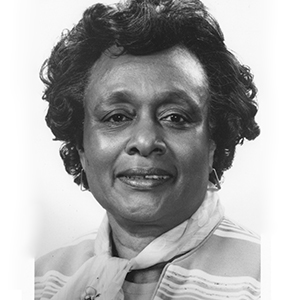
Bertha S. Woodard
(1916-1999)
Reno NAACP Leader, Human Rights Advocate
Bertha S. Woodard worked as a nurse, but dedicated her life to fighting against racial and social injustices in northern Nevada. She was considered by some as the matriarch of the Reno-Sparks branch of the NAACP and served as its local president from 1971 to 1976. For years before the federal Civil Rights Act passed in 1964, activists across the country were campaigning for equal rights in their own communities, and Woodard played an important role in Nevada’s struggle.
African Americans were not permitted as customers at most downtown Reno establishments. Even African American servicemen based at Stead Air Force Base were denied entry and told they had to go to Lake Street, away from downtown. Woodard petitioned the Reno City Council in 1959 to lift a ban on minorities in local casinos and helped lead an effort to remove racially derogatory signs from Reno stores.
She also helped organize a protest against the El Capitan Casino in Hawthorne, which had the only restaurant in town and denied service to African Americans. Non-whites traveling through town were not allowed to stop there for food and rest. After a group began picketing the casino, it eventually changed its policy.
In the spring of 1961, Nevada’s Legislature was considering a bill to establish a state Commission on the Equal Rights of Citizens. The Reno-Sparks chapter of the NAACP was committed to getting the bill through. Woodard and several other members were picketing some downtown Reno businesses that opposed the Equal Rights Commission bill when they decided to eat a meal at the café in the Overland Hotel. When the hostess refused to seat them, Woodard appealed to the manager, then to two city council members and the mayor, to no avail. Charles Kellar, a Las Vegas attorney visiting Reno to help organize support for the Equal Rights bill, came up with a plan.
The next day, a group of African Americans met at the train station and bought newspapers. They then walked next door to the Overland café with their newspapers, sat at the counter and occupied all the tables. The staff put the food away, hung a “Closed” sign on the door and locked it, with the protestors still sitting inside. Since that was a fire hazard, Kellar told one of them to call the fire chief. "Chief Briscoe came down expecting a riot. When he got down there, everybody was just reading the newspaper," Woodard stated.
Since reading the newspaper wasn’t a crime, the doors were unlocked and the crowd slowly dispersed. The peaceful protest was front page news, and just days later, the bill passed. Woodard was one of the people invited to attend when the Governor signed the bill into law. Although Nevada wouldn’t adopt its own comprehensive Civil Rights Act until 1965, the creation of the Equal Rights Commission was a critical first step.
[Photo provided by Special Collections and University Archives Department, University of Nevada, Reno. UNRS-P1997-56-0411]