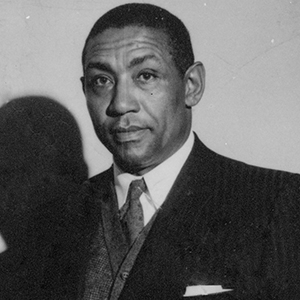
Charles L. Kellar
(1909-2002)
Legal Advocate for Nevada Racial Justice
One of the first African American lawyers in Nevada, Charles L. Kellar devoted his legal career to fighting for racial justice. As a young attorney in New York, he was a colleague of NAACP attorney Thurgood Marshall, who later became the first African American U.S. Supreme Court justice. Marshall urged Kellar to move to Nevada because it was one of several states that had no African American attorneys. After relocating to Las Vegas, Kellar passed the bar exam in 1960 with a near-perfect score, but the state bar withheld his license, and the court battle to get a law license wasn’t decided in his favor until 1965. In the interim, he supported himself by selling real estate and formed close ties with the Las Vegas branch of the NAACP and with Reno’s African American community.
Kellar organized, planned, strategized and picketed with activists in both Las Vegas and Reno, but his main contribution was drafting civil rights legislation for lawmakers to present to the Nevada Legislature. During the 1961 session, Kellar drafted a bill that banned racial discrimination in public accommodations, housing and employment, and established a Commission on Human Relations. When a watered-down version was passed, he joined picketers in Reno and at the Capitol in Carson City protesting the bill, and a new anti-discrimination bill was soon approved and became law.
Kellar led the Las Vegas NAACP branch beginning in 1967. He and his group worked to ensure that Nevada resorts and casinos provided equal employment opportunities for African Americans. He began the legal work that culminated in the Consent Decree in 1971, stipulating that 12 percent of all jobs go to qualified African Americans throughout the industry. He also fought for better education for African American children through calls for school integration and helped overturn local ordinances that allowed police to arrest unemployed African Americans who walked the streets outside of West Las Vegas or were gathered in groups of three or more.
Kellar, who lived to age 93, was able to witness the changes brought about by his determination to get equal treatment for African Americans. In his later years, he told the local newspaper, "Having a cause to fight for gives you a purpose, and having a purpose -- a vision to accomplish something -- is so important. That's what kept me going."
[Photo provided by Special Collections and University Archives Department, University of Nevada, Reno. UNRS-P1997-56-0323]