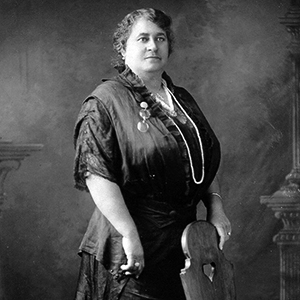
Maggie Lena Walker
(1864-1934)
First Woman to Charter a Bank in the U.S.
Maggie Lena Walker, a businesswoman, teacher, and community leader, was the first woman in the U.S. to charter a bank and serve as its president. She helped make tangible improvements in the way of life for African Americans in her city.
Walker was born in 1864 to an enslaved woman in Richmond, Virginia. When she was just 14, she joined the Independent Order of St. Luke’s, an African American benevolent organization that helped the sick and elderly in Richmond. She went on to hold many high-ranking positions in the organization, an involvement that continued throughout her life. In 1902, she began publishing the organization’s newspaper, which encouraged African Americans to harness their economic power by establishing their own businesses.
Her first business endeavor was a community insurance company for women, and in 1903, she founded the St. Luke Penny Savings Bank and served as its president. This made her the first woman of any race to charter a bank in the United States. In speeches to the community, she said, “Let us put our money together; let us use our money; let us put our money out at usury among ourselves, and reap the benefit ourselves." The bank was a powerful representation of Black self-help in the segregated South. The Penny Savings Bank appealed to children by passing out small banks that encouraged them to save their money, but also attracted adults who wanted to support a bank headed by people in their own community.
By 1924, the Penny Savings Bank had spread to other parts of Virginia and included more than 50,000 members. While other banks collapsed during the Great Depression, St. Luke’s Penny Savings Bank survived. The bank eventually consolidated with two other large banks, which are still in operation today.
In addition to her involvement with the Order of St. Luke's, Walker held leadership positions in many civic organizations, including the National Association of Colored Women, and served as the Vice President of the Richmond chapter of the NAACP. She became a member of the national NAACP board and also served as a member of the Virginia Interracial Commission. An advocate of education and for women’s rights, she served as board member of the Virginia Industrial School for Girls for many years.
After an illness in 1928, Walker was forced to use a wheelchair. Although limited in movement, she remained a leader in Richmond’s African American community and served as an example of the contributions that could be made by disabled people.