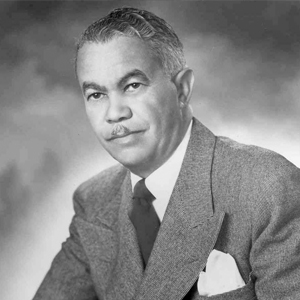
Paul Revere Williams
(1894-1980)
Pioneering African American Architect
Paul Revere Williams was the first African American member of the American Institute of Architects (AIA) at a time when racial prejudice prevented most African Americans from entering a profession dominated by whites.
Although Williams grew up in Los Angeles, where races and ethnicities mixed more freely than in other parts of the country, he was advised in high school to change his plans of becoming an architect because he’d have difficulty attracting clients from the white community. Undeterred, he pursued his dream and developed professional experience with leading design firms in southern California. Certified as a building contractor in 1915, he won an architectural competition in 1919 at the age of 25 and was licensed as an architect by the State of California in 1921. He opened his own practice soon after and became the first African American member of the AIA in 1923.
Being a naturally creative person, Williams found an innovative way to deal with the fact that many of his white clients felt uncomfortable sitting next to an African American man to review drawings. He learned to draft upside-down so he could sit across the desk from his clients, who would see the drafts right-side-up.
Southern California real estate was booming during the 1920s. At first, Williams focused on designing small, affordable houses, but he quickly moved on to designing mansions for the rich and famous. His show business clients included Lucille Ball and Desi Arnaz, Frank Sinatra, Lon Chaney, Danny Thomas, and many others. Williams famously remarked that most of the homes he designed were on parcels whose deeds included segregation covenants barring non-whites from purchasing them.
Although residential design remained an important part of his practice, Williams soon branched out into commercial, institutional and public commissions and expanded his practice into other areas of the US, including Nevada. He was first introduced to northern Nevada in the 1930s by Luella Garvey, for whom he had designed a house in Reno. This connection led to several other residential projects in Lovelock and Reno. His most notable northern Nevada building was the First Church of Christ, Scientist (now known as the Lear Theater) in Reno.
His work in Nevada continued through the 1970s and included private residences, commercial properties, and religious institutions. In Las Vegas, he designed the iconic La Concha Motel (now part of the Neon Museum) as well as the Guardian Angel Cathedral, the Royal Nevada Casino, and Berkley Square, Southern Nevada’s first African American suburban community.
In the course of his five-decade career, he designed thousands of buildings, a number of which are listed on the National Register of Historic Places. In contrast to the luxurious mansions he designed for celebrities, Williams co-designed the first federally funded public housing projects of the post-war period.
In 1957, Williams was the first African American elected a Fellow of the American Institute of Architects and he was awarded AIA's Gold Medal in 2017, an annual honor recognizing individuals whose work has had a lasting influence on the theory and practice of architecture.